
Newsletter
Determination of Essential Technical Features of an Invention
Regarding how patent specifications and claims should be drafted, Paragraphs 1 and 2, Article 26 of the Patent Act provide the following requirements:
Paragraph 1: "The description shall fully disclose the invention in a manner that is clear and sufficient for it to be understood and carried out by a person having ordinary skill in the art."
Paragraph 2: "Claim(s) shall define the claimed invention, and more than one claim may be included therein. Each claim shall be clearly and concisely disclosed and supported by the description."
In addition, Paragraph 2, Article 18 of the Enforcement Rules of the Patent Act further stipulates: "An independent claim shall state the designation of the subject matter as claimed and the essential technical features of the invention that the applicant regards as his/her invention."
Accordingly, the disclosure of the specification must be sufficient to enable a person ordinarily skilled in the art to carry out the invention based on such disclosure, and the claims must be supported by the specification. Moreover, an independent claim must clearly recite the "essential technical features" of the invention.
With that said, the answers to the questions below remain unresolved:
How can it be determined whether a claim clearly defines the essential technical features of an invention?
If a claim also needs to comply with Paragraph 2 of Article 26 of the Patent Act, is the disclosure of the specification considered sufficient to enable a person ordinarily skilled in the art to carry out the invention?
Under current practice, although Section 2.3.1.1 of the Patent Examination Guidelines published by the Taiwan Intellectual Property Office of the Ministry of Economic Affairs provides the criterium for determining whether an independent claim already recites the essential technical feature, the determination of which technical features are indispensable for solving the problem often varies subjectively.
"Essential technical features refer to the technical features that are indispensable for solving the problem of the claimed invention, which as a whole constitute the technical means of the invention, and is the basis of comparison between the claimed invention and the prior art."
In a recent administrative litigation case concerning an invention patent for a stapler (Issuance No. I331096) (hereinafter referred to as "the Patent"), the Supreme Administrative Court rendered Administrative Judgment 114 Shang-Zhi No. 46 on June 26, 2026, elaborating on the approach for determining the essential technical features of an invention.
In the first-instance judgment (Administrative Judgment 113 Xing-Zhuan-Su-Zhi No. 26), the Intellectual Property and Commercial Court (hereinafter referred to as "the IPC Court") referred to the specification of the Patent and indicated that the Patent is intended to solve the problems with the laborious operation and complicated component structure of the flat-stapling mechanism of conventional staplers. To that end, a transmission member is utilized to transmit force to the flat-stapling assembly, thereby enabling the stapler to achieve both labor-saving operation and flat-stapling functionality through its simple and easily assembled design.
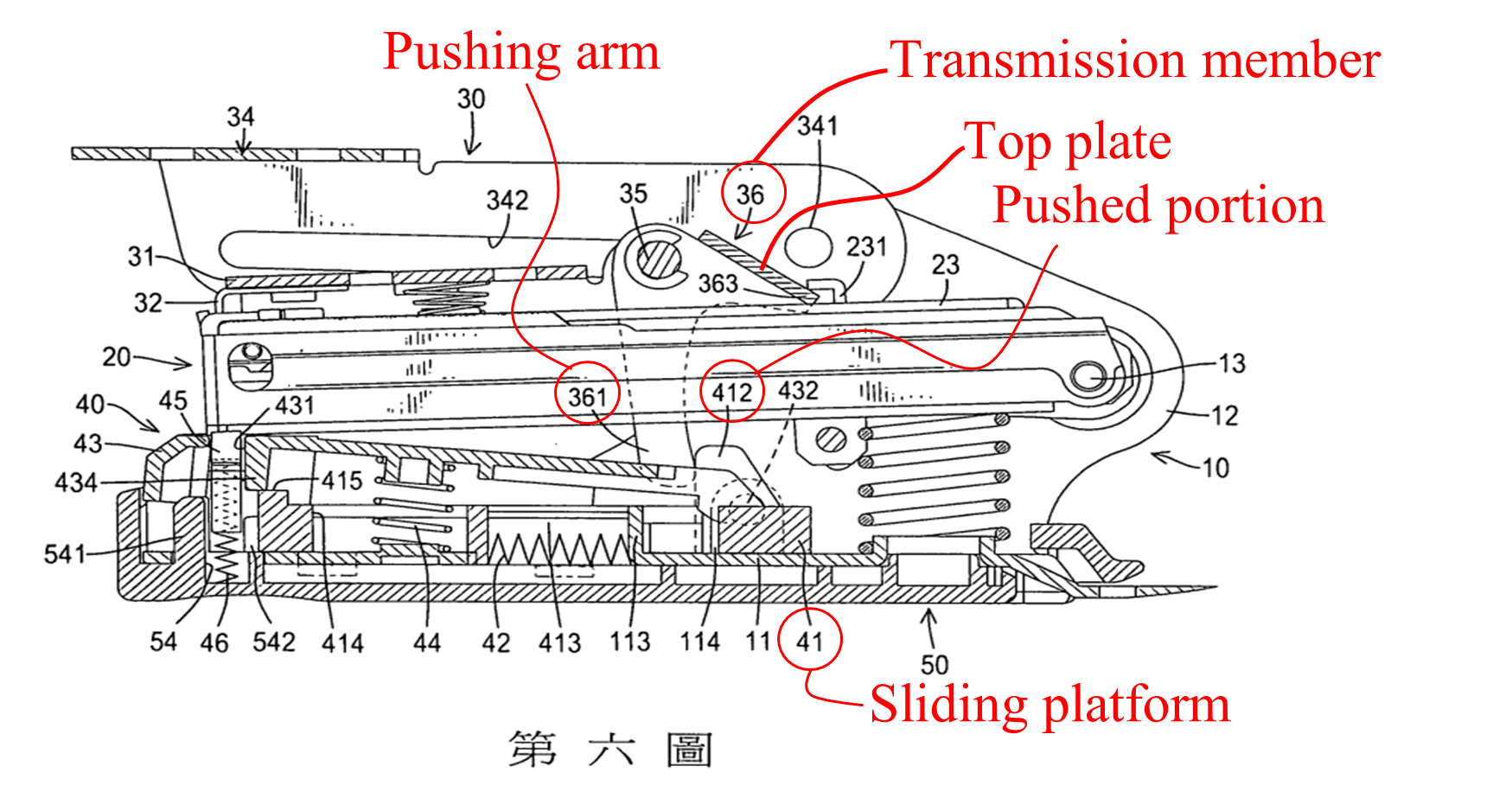
The first-instance judgment further holds that the invention of the Patent has to rely on the fulcrum formed by the "top plate" of the transmission member in order to transmit the reaction force through the pushing arm of the transmission member and to the pushed portion of the sliding platform, which will release the restriction preventing the movable platform from moving downward and thereby achieve the aforementioned objectives of the invention.
Based on the above reasons, the first-instance judgment concludes that the claim of the Patent fails to recite the essential technical feature "top plate," thus violating Paragraph 3, Article 26 of the Patent Act. Accordingly, the IPC court upheld the administrative appeal decision and dismissed the plaintiff's appeal. (Figure 6 of the Patent is reproduced below with the relevant components added.)
However, the Supreme Administrative Court held a different view and revoked the IPC Court's first-instance judgment with Administrative Judgment 114 Shang-Zhi No. 46.
Regarding the problem the invention of the Patent is intended to solve, the Supreme Administrative Court's determination is generally the same as that of the IPC Court. However, in determining the essential technical features of the invention, the Supreme Administrative Court refers to the following disclosure in the specification of the Patent and points out that Claim 1 of the Patent already clearly recites the following: "The shaft member is laterally inserted through a middle portion of the pressing handle; the transmission member is coupled to the pressing handle through the shaft member inserted therethrough, and a pair of pushing arms extends downward from both sides of the transmission member, the lower ends of the pair of pushing arms extending over the bottom side of the staple magazine assembly"; and "A flat-stapling assembly, mounted at the front portion of the base, includes a sliding platform, a movable platform, and a staple-groove member; the sliding platform is assembled to the base in a manner that it can slide forward and backward, and is provided with a pushed portion corresponding to the pair of pushing arms." Accordingly, the Supreme Administrative Court holds that the claim has clearly recited the essential technical features of the invention.
"In the present invention, the transmission member (36) used to control and drive the flat-stapling assembly (40) is mounted and coupled to a middle section of the pressing handle (31). When the pressing handle (31) is pressed downward with its rear end serving as a pivot, the arched pushing arms (361), which extend downward from the transmission member (36), can directly control and drive the flat-stapling assembly (40), thereby effectively achieving the effect of structural simplification and precise operational control."
The appellate court also emphasized that, according to the following disclosure in the specification of the Patent, the "top plate" of the transmission member is intended to enable the transmission member to move in a small angular range together with the pusher member, rather than to form a fulcrum by having the rear end of the top plate abut against the top surface of the pusher member. The appellate court therefore holds that the transmission member including the "top plate" is merely one of the preferred embodiments of the Patent, and that the "top plate" is not an essential technical feature of Claim 1.
"A locking portion (363) is provided at the rear end of the top plate of the transmission member (36), and can engage with a hook portion (231) provided on the top surface of the aforementioned pusher member (23), thereby enabling the transmission member (36) to move in a small angular range together with the pusher member (23)."
It can be inferred from the second-instance judgment that, in determining the essential technical features, the Supreme Administrative Court relies on the technical features and components described in the embodiments of the specification of the Patent concerning how the problem is solved and how the technical effects are achieved. That is, the appellate court focuses the scope of the essential technical features on the components that are indispensable for solving the problem and achieving the technical effects.
In contrast, it appears from the first-instance judgment that the IPC Court, in determining the essential technical features, takes into consideration the collaborative relationships among the structures and components disclosed in the specification and drawings of the Patent and therefore concludes that the "top plate" is an essential technical feature. It appears that the IPC Court's conclusion is based mainly on the reasoning that the "the stapler cannot perform the flat-stapling operation without the 'top plate'." However, the IPC Court's consideration regarding "whether the stapling operation can be completed or not" seems to fall within the scope of Paragraph 2, Article 26 of the Patent Act—the specification should be sufficiently disclosed to enable a person ordinarily skilled in the art to carry out the invention.
The judgments rendered in this case demonstrate that the determination of the essential technical features of an invention may lead to entirely different outcomes depending on how the court defines the scope of the technical features that solve the relevant problem. This is particularly true for patents in which the desired technical effects are achieved through the collaboration of several components. Therefore, we look forward to more case laws concerning this issue, which will be helpful in precisely determining which technical features among numerous collaborative components are essential for solving the relevant problems.