

Newsletter
Recent Court Case: Responding to Patentee Doctrine of Equivalents Claim with Prosecution History Estoppel and Practicing Prior Art
"Prosecution history estoppel" refers to the scenario of the patentee, during patent application or maintenance, effecting amendment/post-grant amendment, or presenting arguments, resulting in substantial narrowing of the scope of the patent to overcome defects in patentability. In such cases, the patentee is precluded from subsequent extension of the scope of the patent, through the doctrine of equivalents, to what was previously surrendered.
In Intellectual Property and Commercial Court Civil IP Case No. 7 (2026), the defendant successfully invoked prosecution history estoppel and practicing prior art argument to convince the court that, based on the principle of prosecution history estoppel, the plaintiff's doctrine of equivalents claim was unfounded.
I. Case Summary
1. The plaintiff alleged that the defendant infringed its utility model patent TWM616734, titled "Positioning Device for the Ultimate Position of Rolling Door Movement."
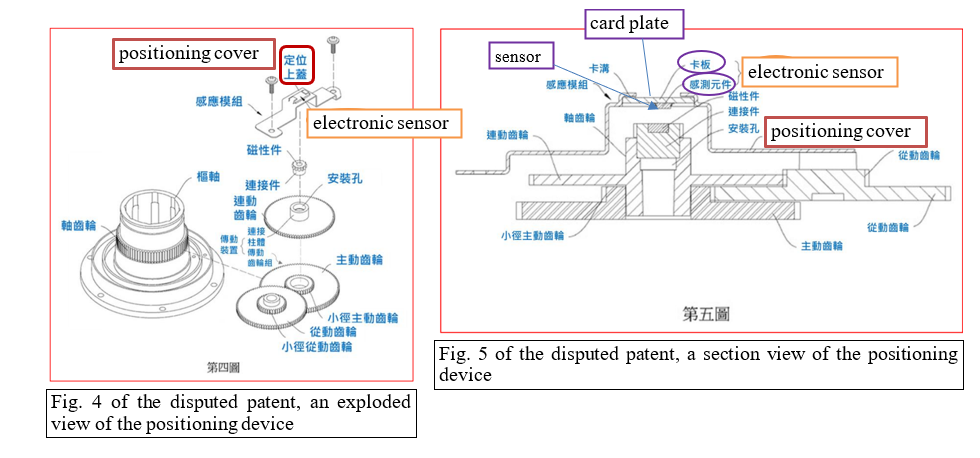
2. The defendant argued that, during invalidation proceedings, the plaintiff had amended Claim 1 to add the technical feature "the positioning upper cover comprises a slot; the electronic sensor comprises a card plate and a sensing element disposed on the card plate; the card plate is engaged in the slot to fix the electronic sensor to the positioning upper cover." The amendment narrowed the scope of the disputed patent and constituted a waiver of part of the patent. Accordingly, the principle of prosecution history estoppel should apply, and the plaintiff should not be allowed to assert doctrine of equivalents infringement for the surrendered portion.
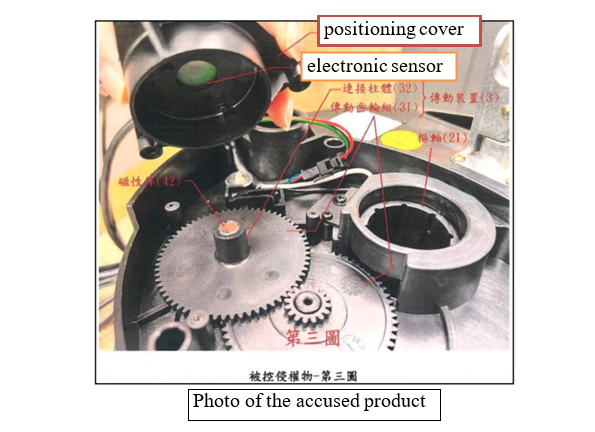
3. The defendant further contended that its product utilizes upper and lower cover shells to position the magnetic pole substrate above a magnet embedded on a connecting post. Such structure is a simple combination and modification of the prior art reference TWM414485 and common knowledge at the time that the disputed patent application was filed with the patent office. The structure of the accused product embodies prior art, such that the practicing prior art defense applies, precluding a finding of infringement under the doctrine of equivalents.
II. Court's Reasoning
The following is an abstract of the court's reasoning relevant to the defendant's prosecution history estoppel and practicing prior art defense.
1. The feature of Claim 1 of the disputed patent "the positioning upper cover comprising a slot; the electronic sensor comprising a card plate and a sensing element disposed on the card plate; the card plate engaged in the slot to fix the electronic sensor to the positioning upper cover" (hereinafter referred to as "Feature E") is absent from the accused product, and thus the accused product constitutes no literal infringement.
2. Feature E was added to Claim 1 by the plaintiff during post-grant amendment. Therefore, the plaintiff has limited the method of fixing the electronic sensor to only the manner in which the card plate of the electronic sensor is engaged in the slot of the positioning upper cover to fix the electronic sensor to the surface of the positioning upper cover. According to the principle of prosecution history estoppel, the plaintiff should not be allowed to expand Feature E of Claim 1 via the doctrine of equivalents to cover the accused product’s technical solution, namely, "the electronic sensor is accommodated in the receiving portion of the module lower cover, and the module upper cover and lower cover are ultrasonically welded at their contact interface to form an integrated structure, thereby enclosing and clamping the electronic sensor between the module upper and lower covers." Therefore, there is no infringement under the doctrine of equivalents.
III. Commentary
1. The defendant asserted no patent invalidity based on prior art evidence in this infringement litigation, mainly because the plaintiff had already narrowed the scope of Claim 1 of the disputed patent during invalidation proceedings and successfully persuaded the Intellectual Property Office that the narrowed scope possessed inventive step.
2. Upon review, the main prior art evidence in the invalidation proceedings was TWM414485. The defendant considered the structure of its product similar to that disclosed in this prior art, and thus presented the practicing prior art argument, emphasizing that the disputed patent had been amended to distinguish it from prior art TWM414485, and that the accused product adopted a structure similar to that disclosed in TWM414485. Thus, the accused product was not within the scope of the disputed patent.
3. The defendant also invoked the principle of prosecution history estoppel, prompting the court to review the prosecution history and confirm that the disputed patent's scope was valid only after being narrowed by amendment, and should not be expanded through the doctrine of equivalents to cover the pre-amendment scope, which overlaps with the prior art TWM414485.
4. By invoking the practicing prior art defense and the principle of prosecution history estoppel, the defendant successfully directed the court's attention to the differences between the accused product and the disputed patent, leading to the conclusion that the accused product constituted no literal or equivalent infringement. The court's reasoning on non-infringement was also comprehensive.